Rigid vs Flexible Insulation
Insulation & Damp › Insulation & Damp
Rigid vs Flexible Insulation
Choose the right insulation type to cut heat loss and avoid costly mistakes.
Rigid insulation boards offer higher thermal performance per millimetre and suit solid walls and floors. Flexible insulation rolls and batts are cheaper, easier to cut, and ideal for lofts and stud walls. Your choice depends on the application, available space, and budget.

What Is Rigid Insulation?
Rigid insulation is a solid, factory-manufactured board — typically made from polyisocyanurate (PIR), expanded polystyrene (EPS), or extruded polystyrene (XPS) — that is cut to size and fixed in place. It delivers a high thermal resistance (low lambda value) relative to its thickness, making it the preferred choice where space is limited, such as solid wall insulation, floor build-ups, and flat roofs. For a full overview of where rigid boards fit into your home, see the Insulation & Damp Guide. Installation requires accurate measuring and cutting with a sharp knife or fine-toothed saw, and boards must be taped at joints to prevent cold bridging. See our Solid Wall Insulation Guide for step-by-step instructions on fitting rigid boards to walls.
What Is Flexible Insulation?
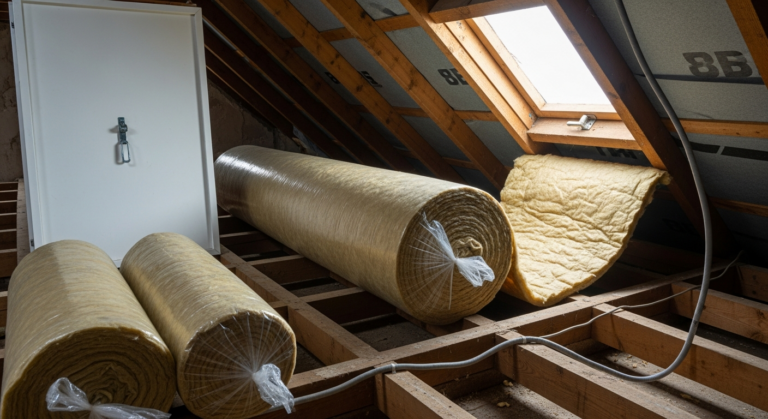
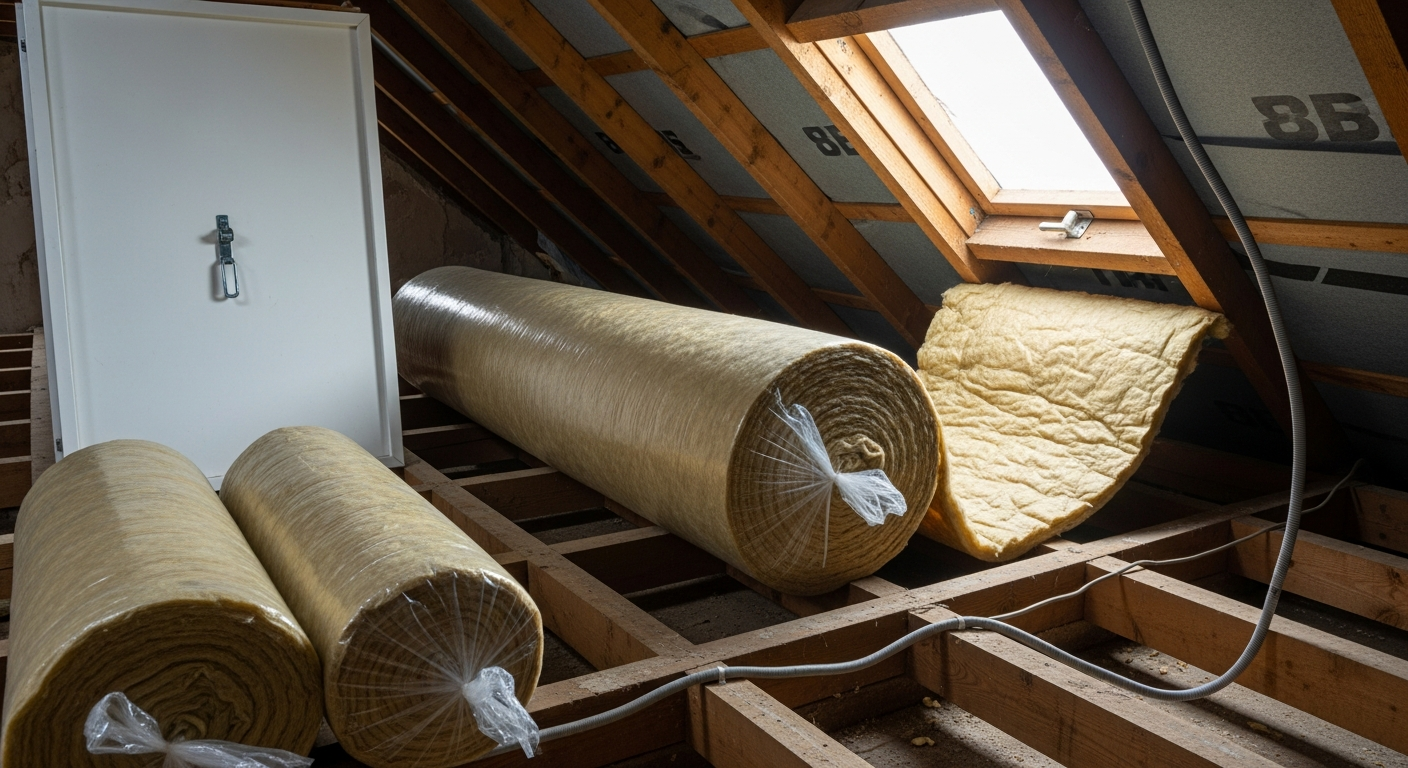
Flexible insulation comes in rolls or pre-cut batts and is most commonly made from mineral wool (glass wool or rock wool), although sheep’s wool and recycled plastic fibre options are also available. It compresses for handling, springs back to fill cavities evenly, and is straightforward to cut with a bread knife or insulation knife. It is the standard choice for loft floors, timber stud walls, and between floor joists. For detailed fitting instructions, visit our How to Insulate a Loft guide. Flexible insulation performs best when it completely fills the void without compression; compressing mineral wool reduces its thermal resistance.
Side-by-Side Comparison
| Factor | Rigid Insulation | Flexible Insulation |
|---|---|---|
| Cost per m² | £5–£20+ depending on thickness and type | £2–£8 for mineral wool rolls/batts |
| Durability | Excellent — does not sag or settle over time | Good — mineral wool is stable; natural fibres may settle slightly |
| Appearance | Neat, flat boards; easy to skim or dot-and-dab over | Hidden behind plasterboard or within voids; not finished |
| Install Difficulty | Moderate — requires accurate cuts and taped joints | Low — cuts easily, no specialist tools needed |
| Maintenance | None once installed correctly | Inspect periodically in accessible areas for settlement or moisture |
| Lifespan | 50+ years in a dry environment | 25–50 years depending on material and conditions |
Rigid Insulation — Pros and Cons
- Higher thermal resistance per millimetre — ideal where depth is limited
- Does not absorb moisture (XPS and foil-faced PIR especially)
- Dimensionally stable — no settling or slumping over time
- Can be used externally (e.g., under render or on flat roofs)
- Some boards have foil facing, adding a vapour control layer in one step
- More expensive per m² than flexible alternatives
- Cutting produces dust and offcuts that must be disposed of responsibly
- Joins must be taped carefully to avoid cold bridges
- Less forgiving of irregular surfaces — voids left unfilled will reduce performance
Flexible Insulation — Pros and Cons
- Lower cost per m² — the most budget-friendly option for large areas
- Easy to handle and cut without specialist tools
- Conforms to irregular joist or stud spacings when fitted correctly
- Mineral wool is non-combustible — useful in fire-stopping applications
- Wide availability from builders’ merchants and DIY outlets
- Thicker depths required to match the thermal performance of rigid boards
- Must not be compressed — reduces thermal resistance significantly
- Can absorb moisture if vapour control is not correctly installed
- Skin and respiratory irritant during installation — PPE (gloves, dust mask, goggles) essential
Which Is Better For…?
- Loft floor insulation in a cold roof: Flexible insulation wins. Two layers of mineral wool rolls laid at right angles — 100mm between joists, 170mm across — meets current Building Regulations guidance at minimal cost. See our Loft Insulation Depth Guide for recommended thicknesses.
- Solid wall internal insulation where space is tight: Rigid insulation wins. A 50mm PIR board fixed directly to the wall and dot-and-dabbed with plasterboard loses far less floor space than an equivalent mineral wool stud wall build-up.
- Suspended timber floor between joists: Flexible insulation wins. Mineral wool batts cut 10–15mm wider than the joist spacing friction-fit securely without adhesive and are cheaper to buy and faster to install. Visit our guide on how to Insulate a Cold Floor for full instructions.
- Flat roof or inverted roof insulation: Rigid insulation wins. XPS or PIR boards are moisture-resistant, load-bearing, and can sit above the waterproof membrane in an inverted roof construction — flexible materials are unsuitable here.
- Timber-frame stud partition walls: Both work well. Flexible mineral wool batts are cheaper and easier to fit between studs; rigid boards can be used where a higher acoustic performance or slimmer build-up is needed.
UK Cost Comparison
Flexible mineral wool insulation rolls and batts typically cost between £2 and £8 per m² depending on thickness (50mm to 200mm) and density. Rigid PIR boards — the most common type sold in builders’ merchants — generally run from £5 to £20+ per m², with thicker or foil-faced boards at the upper end. EPS (expanded polystyrene) boards sit at the more affordable end of the rigid range, from around £3–£10 per m². XPS, which is more moisture-resistant and suited to below-ground or inverted roof use, is typically the most expensive rigid option. Always compare products on lambda value (W/mK) and required thickness to achieve the same U-value, rather than price per board alone — a cheaper product requiring twice the depth may cost more overall once labour and space loss are factored in. If you are also addressing moisture issues alongside insulation, see our guidance on how to Fix Condensation Damp before specifying your insulation type.
Frequently Asked Questions
Can I use flexible insulation on a solid wall?
Yes, but you will need to build a timber stud frame to hold the batts, which adds depth and reduces floor space. Rigid boards are usually more practical for solid walls where space is at a premium.
Does rigid insulation need a vapour barrier?
Foil-faced PIR boards act as a vapour control layer on the warm side of the build-up, but joints must be sealed with foil tape. Unfaced boards, EPS, and XPS still require a separate vapour control layer on the warm side in most wall and floor applications.
Is flexible mineral wool fireproof?
Mineral wool (glass wool and rock wool) is non-combustible and carries an A1 or A2 Euroclass fire rating, making it suitable for use in fire-stopping details. PIR rigid boards are combustible and must be protected by a minimum 12.5mm plasterboard layer in occupied spaces.
How thick does rigid insulation need to be to meet current Building Regulations?
Required thickness varies by application and the existing construction. As a rough guide, a 70–80mm PIR board (lambda ~0.022 W/mK) fitted to a solid wall will typically achieve a U-value around 0.30 W/m²K, but you should calculate the full U-value for your specific wall construction to confirm compliance.
Can flexible and rigid insulation be combined in the same build-up?
Yes — this is common practice, particularly in warm loft (roof) constructions where rigid boards sit between and below rafters, with flexible mineral wool filling the rafter depth. Combining the two can help achieve target U-values while managing depth constraints.
When fitting rigid PIR boards to a wall, use a contrasting colour of foil tape at joints — silver tape on a silver board is easy to miss. Untaped joints can account for a significant proportion of heat loss in an otherwise well-insulated wall, undermining the entire installation.
Sources
- Energy Saving Trust — Insulation: where to insulate and what type to use — energysavingtrust.org.uk
- GOV.UK — Approved Document L: Conservation of fuel and power — gov.uk
- HSE — Mineral wool insulation: health and safety guidance for installers — hse.gov.uk
This guide is for general information only. Always work safely and follow manufacturer instructions. DIYnut accepts no liability for injury or damage arising from DIY work.