Flooring: Complete UK DIY Guide 2026
Flooring: Complete UK DIY Guide 2026
Flooring is one of the highest-impact DIY jobs you can tackle — get it right and it transforms a room, get it wrong and it’s an expensive redo. This guide covers the three areas UK homeowners ask about most: Wood & Laminate installation, Vinyl laying, and Repairs to existing floors. Whether you’re starting from scratch or fixing a problem, you’ll find straight-talking advice based on real trade experience here.
Browse Flooring Guides
Laminate Flooring
Repairs
Vinyl & LVT
Hardwood & Engineered
Materials Guide
Common Problems
Trade vs DIY
Frequently Asked Questions
Do I need underlay under laminate flooring in a UK home?
Yes, in almost every case — underlay provides thermal insulation, absorbs sound, and protects the locking joints from unevenness in the subfloor. Some laminate comes with underlay pre-attached, in which case you should not add an additional layer as it creates too much give and stresses the click joints. On concrete subfloors, use an underlay with a built-in DPM (damp proof membrane) to prevent moisture rising through.
What’s the difference between engineered wood and laminate flooring?
Engineered wood has a real timber veneer on top bonded to layers of plywood, so it looks and feels like solid wood but is more dimensionally stable — it handles UK humidity changes better than solid wood. Laminate has a photographic layer under a wear coating, meaning it’s not real wood at all and cannot be sanded back if it gets scratched or worn. For longevity and resale appeal, engineered wood wins, but good quality laminate is a perfectly respectable budget option.
How much expansion gap should I leave around laminate or engineered wood flooring?
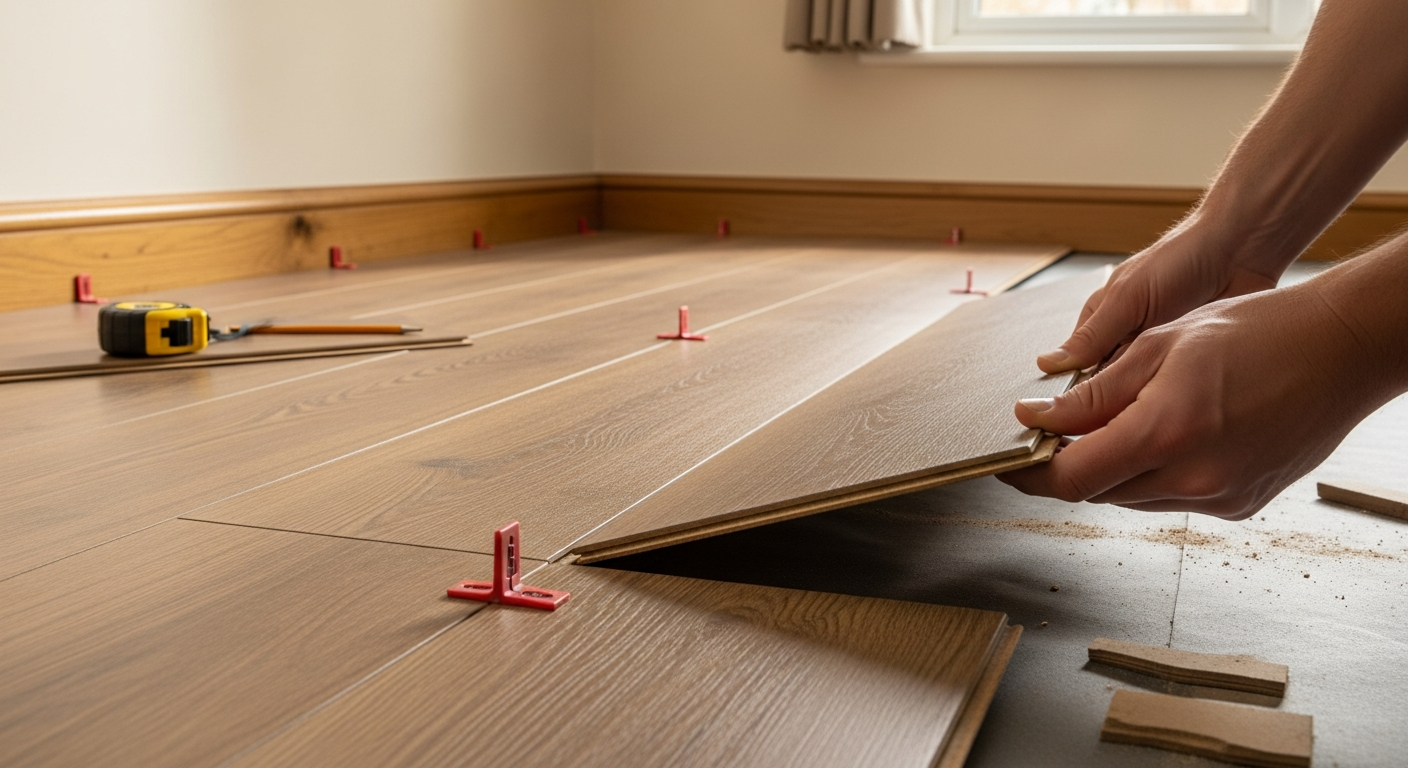
As a rule, leave a minimum of 10–12mm around all fixed edges — walls, door frames, pipes, and any other rigid structure. Wood expands and contracts with temperature and humidity, and if it has nowhere to go it will buckle, which is one of the most common and entirely avoidable DIY flooring mistakes. Cover the gap with a matching beading or skirting board — never fill it with sealant or adhesive.
Can I lay LVT or laminate over existing floor tiles?
You can, provided the tiles are fully adhered, level, and in good condition — loose or cracked tiles must be fixed or removed first, as any movement underneath will telegraph through and damage your new floor. Check the total floor height won’t cause problems at doorways or thresholds before you start, as LVT plus any underlay adds up quickly. In bathrooms, always check the manufacturer’s guidance, as some floating floors aren’t suitable over underfloor heating or in high-moisture areas.
What causes a squeaky floorboard and how do I fix it?
Squeaks are nearly always caused by two pieces of timber rubbing against each other — usually a floorboard moving against a joist, a nail that’s worked loose, or boards rubbing side-to-side. If you can access from below, screwing up through the joist into the board is the most effective fix; from above, countersink screws directly into the joist and fill the holes. Talcum powder or specialist squeak solution worked into the joints is a temporary measure that can buy time, but a proper mechanical fix is always the right answer.
- Which? — Best flooring types UK — which.co.uk
- GOV.UK — Building Regulations Part C (moisture) — gov.uk
Get the Full Guide with DIYnut AI
Photograph your space, tell the app what you want, and get an AI-generated after image, full materials list, and step-by-step guide in seconds.