Gutters Overflowing
Gutters overflow most often because of a blockage caused by leaves, moss, or debris. Clear the obstruction first, then check for sagging, misalignment, or cracked sections. Most causes are straightforward DIY fixes requiring basic tools and a sturdy ladder.

What’s Causing This?
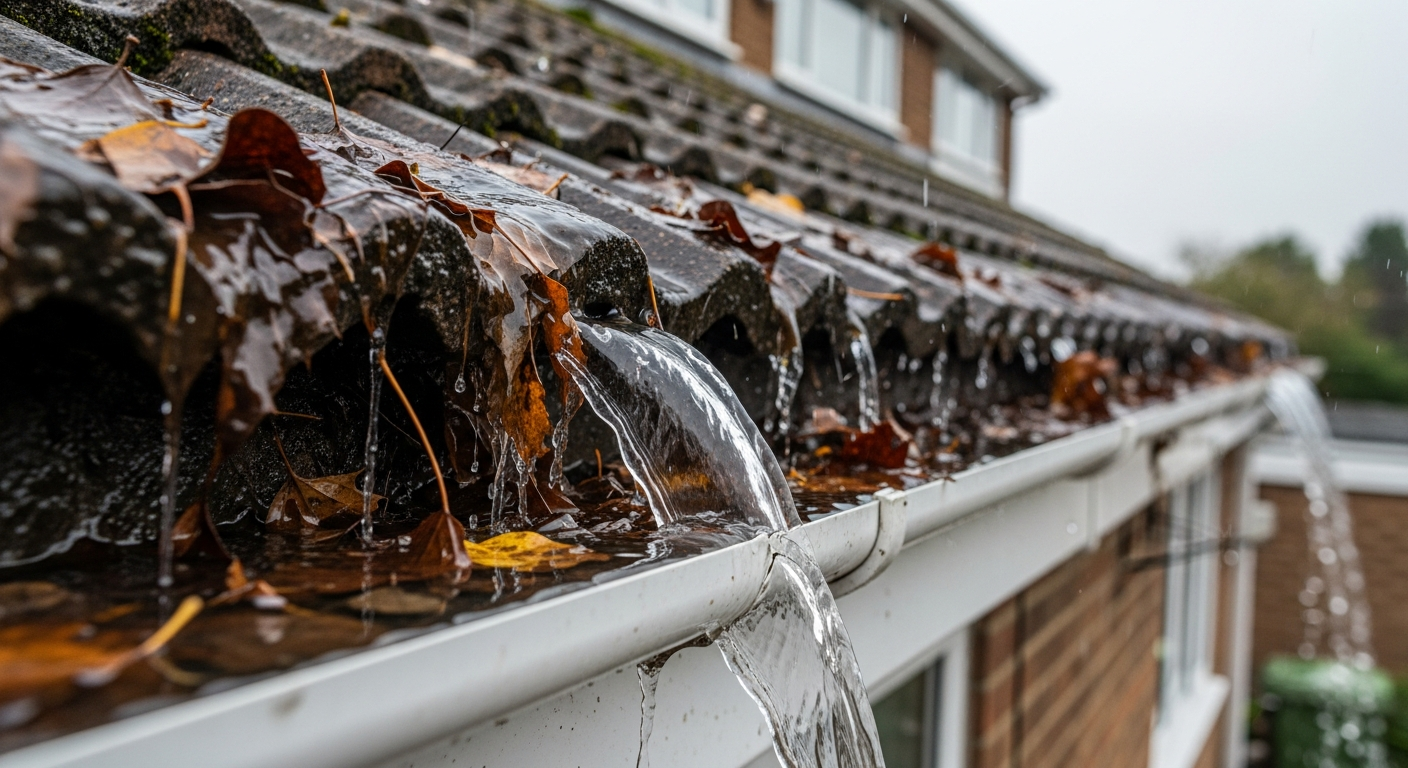
Blocked gutters (most common). Leaves, moss, roof grit, and bird debris accumulate in the gutter channel, forming a dam that causes water to spill over the front lip. This is especially common after autumn or following work on the roof. See our guide on how to clear blocked gutters to sort this quickly.
Sagging or misaligned gutter. Gutters must fall gently towards the downpipe — typically around 1:600 fall. If brackets have failed or the fascia behind them has rotted, the gutter sags and water pools, then overflows mid-run rather than draining away. Read more in our guide to fixing a sagging gutter.
Cracked, split, or leaking gutter section. UV exposure, frost, and age cause uPVC and cast-iron gutters to crack. Water escapes through the crack rather than reaching the downpipe, running straight down the wall. Our fix leaking gutters guide covers repair options.
Undersized or inadequate gutter. If a gutter was originally sized for a small roof section but the roof area has since changed — or was never correctly sized — it will overflow in heavy rain even when clear. This is more common on extensions with a larger catchment area feeding into the original gutter run.
Blocked or damaged downpipe. The gutter itself may be clear, but if the downpipe outlet is blocked with compacted debris or the pipe is crushed or offset, water backs up and overflows at the nearest low point. Check the full run from outlet to drain before assuming the gutter is the problem.
How to Diagnose the Exact Cause
- Observe during rainfall. Watch from ground level where exactly the water is coming over. Overflow mid-run points to a blockage or sag. Overflow at the downpipe end suggests a blocked downpipe outlet. Overflow at a joint suggests a leaking union.
- Inspect the gutter from a ladder. Set a ladder safely on firm ground, wear non-slip footwear, and work with a helper to steady the base. Look inside the channel for visible debris, moss mats, or standing water. A pool of water when it hasn’t rained recently confirms a low spot or blockage.
- Check the fall angle. Place a spirit level along the gutter run. There should be a very slight fall towards the downpipe outlet. A reverse fall or flat section will hold water and cause overflow.
- Inspect brackets and fascia board. Press gently on the gutter at each bracket point. Movement or a bracket that pulls away from the fascia indicates rot behind it. Check for soft, spongy fascia timber — if the fascia is failing, the gutter cannot be re-secured without first replacing it. See our guide to replacing fascia and soffit boards.
- Check the downpipe. Unclip the downpipe from the wall and look down from the top. Pour a bucket of water into the gutter and observe whether it flows freely to the drain. Gurgling or slow drainage confirms a blockage lower in the pipe.
- Check for cracks and joint failures. Run your hand along the underside of the gutter after rain, or pour water in and watch for drips. Failed union seals and hairline cracks are easily missed from ground level.
How to Fix It
Blocked gutters: Remove debris by hand or with a gutter scoop working from the far end towards the downpipe outlet. Flush through with a garden hose. For persistent organic build-up, a diluted disinfectant wash prevents rapid regrowth. Full step-by-step in our clear blocked gutters guide.
Sagging gutter: Re-set bracket positions to restore the correct fall, replacing any failed brackets. If the fascia behind is rotten, that must be replaced before re-fixing brackets — a bracket screwed into rotten timber will not hold. Follow our fix a sagging gutter guide for the full method.
Cracked or split gutter section: Small cracks in uPVC can be sealed temporarily with waterproof gutter sealant applied from the inside, but a cracked section is best replaced. For cast iron, a patch repair may be appropriate. See how to replace a gutter section for a lasting repair.
Undersized gutter: Upsize the gutter profile — a deep-flow or high-capacity profile handles significantly more rainwater than a standard half-round section. This is a full replacement job but straightforward DIY using the same method covered in our gutter section replacement guide.
Blocked downpipe: Disconnect the downpipe sections and clear the blockage using a drain rod or high-pressure hose. Reassemble and test the full run. If the underground drain is blocked, this may require a drain rod set or professional jetting.
When to Call a Tradesman
Most gutter repairs are safe DIY tasks provided you use a correctly rated ladder, work with a helper, and do not lean out beyond the stiles. However, you should call a qualified tradesman if: the gutter is above two storeys where working at height risk increases significantly; the fascia board is extensively rotten and structural timbers may be affected; the overflow is causing damp penetration into the wall cavity, which may need investigation by a damp specialist; or the downpipe connects to a shared or underground drainage system that requires a registered drainage contractor to clear legally. The HSE’s working at height regulations apply to anyone — not just contractors — so assess your own risk honestly before climbing. For context on water damage to walls, the Walls & Plastering Guide explains what prolonged damp can do to internal finishes.
How to Prevent It Happening Again
- Clear gutters every autumn and spring. A twice-yearly check removes the leaf and moss build-up before it compacts into a blockage. After heavy storms, a quick visual check from ground level is good practice.
- Fit gutter guards. Mesh or brush-style guards sit inside the channel and prevent large debris entering while allowing water through. Our guide to installing gutter guards explains the options and how to fit them.
- Check brackets and fixings annually. A quick inspection each year — especially after a hard frost — catches failing brackets before the gutter starts to sag and overflow.
- Address roof moss before it reaches the gutter. Moss growth on the roof sheds into gutters and accelerates blockages. Treating roof moss early reduces the volume of debris entering the gutter system each year.
Frequently Asked Questions
Why does my gutter overflow only in heavy rain?
This usually means the gutter is either undersized for its roof catchment area, or there is a partial blockage that restricts flow under high volume conditions. A completely clear, correctly sized and aligned gutter should handle typical UK rainfall without overflowing.
Can overflowing gutters cause damp inside the house?
Yes. Water cascading down the exterior wall can saturate render, mortar joints, and cavity insulation, leading to penetrating damp on interior walls. Addressing the gutter quickly limits the damage and avoids more costly remedial work.
How often should gutters be cleaned in the UK?
Twice a year is the standard recommendation — once in late autumn after the leaves have fallen, and once in spring. Properties near trees or with mossy roofs may need more frequent attention.
Is it safe to clean gutters myself?
Yes, for single and two-storey properties, provided you use a correctly rated ladder on firm, level ground and have someone to foot it. The HSE advises against overreaching — move the ladder rather than stretching sideways.
My gutter overflows at the joint between two sections — what’s wrong?
The union seal between sections has most likely failed, or the joint has pulled apart slightly due to thermal movement. Clean out the joint, apply fresh gutter sealant, and clamp until cured — or replace the union connector if it is cracked.
When re-setting gutter fall, set your string line from the downpipe outlet bracket first, then work back to the highest point — even experienced roofers occasionally set the fall in the wrong direction. A 6mm drop per metre of run is sufficient; any more and the gutter appears visibly sloped and water may splash at the outlet end in heavy rain.
Sources
- HSE — Working at Height Regulations 2005: guidance for homeowners and contractors — hse.gov.uk
- Which? — How to clean gutters: step-by-step guide — which.co.uk
- Checkatrade — Average cost to repair or replace guttering in the UK — checkatrade.com
This guide is for general information only. Always work safely and follow manufacturer instructions. DIYnut accepts no liability for injury or damage arising from DIY work.