Condensation Problems
Insulation & Damp › Insulation & Damp
Condensation Problems
Identify the exact cause of condensation and fix it for good.
Condensation forms when warm, moist air meets a cold surface. The most common cause is poor ventilation combined with inadequate insulation. Most cases are DIY-fixable by improving airflow, increasing insulation, or sealing draughty gaps around windows and doors.

What’s Causing This?
Poor ventilation is the most common cause of condensation in UK homes. When moist air from cooking, bathing, and breathing has nowhere to escape, it hits cold walls, windows, and ceilings and turns to water. Improving airflow is usually the first fix — see our Insulation & Damp Guide for a full overview of where to start.
Insufficient insulation causes wall and ceiling surfaces to stay cold enough to trigger condensation even in a reasonably ventilated home. Cold bridging — where insulation is patchy or missing — creates localised cold spots where moisture settles first. Check your loft insulation depth, as a thin layer is a common culprit; our Loft Insulation Depth Guide explains what’s adequate.
Failed or missing window seals allow cold air to penetrate around the frame, keeping glazing and surrounding walls colder than they should be. This produces the characteristic bands of condensation and mould at window reveals. You can assess the seal yourself — see Replace a Window Seal for guidance.
Condensation inside double glazing — water between the panes rather than on the surface — indicates a failed unit seal, not a ventilation problem. The sealed unit needs replacing rather than cleaning. Our guide on Fix Condensation in Double Glazing explains when a unit can be repaired and when to replace it.
Solid or uninsulated external walls remain cold throughout winter and produce persistent condensation on interior surfaces, particularly in older pre-1920 properties. This requires a more involved solution — see our Solid Wall Insulation Guide to understand your options.
How to Diagnose the Exact Cause
- Check where the condensation appears. On window glass only? Likely poor ventilation or a temperature differential issue. On walls near windows and corners? Probably cold bridging or insufficient insulation. Between the panes of a double-glazed unit? The sealed unit has failed — this is not a ventilation issue.
- Run the tissue test. Hold a dry tissue against the affected wall. If it becomes damp or limp, moisture is present in the surface. If the wall also feels cold to the touch, inadequate insulation is the likely cause rather than ventilation alone.
- Check your extractor fans. Turn on the kitchen or bathroom extractor and hold a tissue near the grille. If it doesn’t draw the tissue towards it, the fan is blocked, faulty, or underpowered — and moist air is not being removed at source.
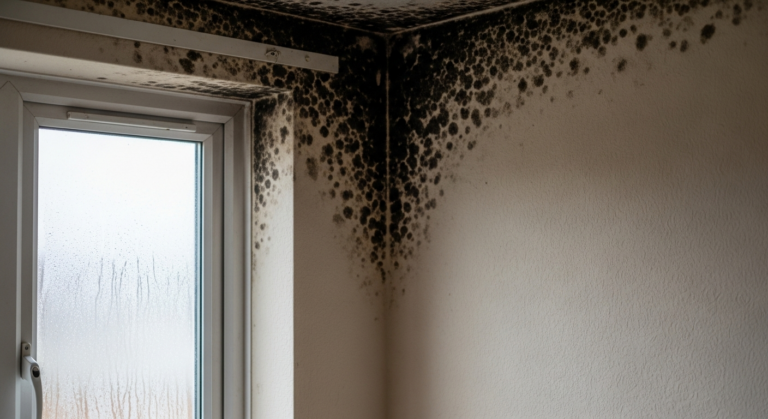
- Look for existing mould patterns. Mould in one corner of an outside wall points to a cold bridge. Mould spreading across a whole wall or ceiling suggests chronic poor ventilation. Mould exclusively around window frames points to a failed seal.
- Rule out rising or penetrating damp. Condensation damp is worse in winter and improves in summer. Rising damp leaves a tide mark; penetrating damp follows rain events. If the damp pattern doesn’t match condensation behaviour, read our guide on Rising Damp vs Condensation before proceeding.
- Inspect the loft hatch. A poorly insulated or unsealed loft hatch lets cold air flood down from the loft into the room below, significantly cooling ceiling surfaces and walls. Check for gaps and missing insulation around the hatch.
How to Fix It
Poor ventilation: Improve background ventilation by installing trickle vents in windows, ensuring extractor fans vent directly outside (not into the loft void), and keeping internal doors open to allow air circulation. Our guide on Fix Condensation Damp covers practical ventilation improvements step by step.
Insufficient loft insulation: Top up loft insulation to the recommended depth. Start with the loft hatch — see Insulate a Loft Hatch — then address the loft floor using the Loft Insulation Depth Guide.
Failed window seal: Replace the rubber perimeter seal around the frame to eliminate the cold air infiltration point. Full instructions are in our Replace a Window Seal guide.
Condensation between double-glazed panes: The sealed unit has broken down and needs replacing. Get the unit size measured accurately — see How to Measure for Replacement Windows — and fit a new unit or instruct a glazier.
Cold solid walls: Internal or external wall insulation will raise the surface temperature and eliminate condensation at source. Review your options in the Solid Wall Insulation Guide.
Black mould already present: Once the underlying cause is resolved, treat existing mould. Full removal steps are in our guide on Fix Black Mould on Walls.
When to Call a Tradesman
Call a qualified damp specialist if mould is extensive (covering more than one square metre of wall), if damp patches persist after ventilation and insulation improvements, or if you cannot determine whether the problem is condensation or penetrating damp. Misdiagnosing the cause and treating the wrong problem wastes money and can make matters worse.
Cavity wall insulation installation must be carried out by a registered installer under the requirements of PAS 2030 — this is not DIY work. If you are considering cavity wall or solid wall insulation as part of a funded scheme (such as the Great British Insulation Scheme), the installer must be certified; check gov.uk for current eligibility. For any mould affecting more than one room or returning repeatedly despite remediation, the HSE advises seeking professional assessment, particularly if vulnerable occupants (elderly, young children, or those with respiratory conditions) are present.
Replacing a failed double-glazed sealed unit is often a straightforward trade job rather than a full window replacement — call a glazier for a quote before assuming you need new windows.
How to Prevent It Happening Again
- Ventilate at source: Always use extractor fans when cooking or showering and leave them running for at least 15 minutes after you finish. Ensure fans duct directly outside, not into a loft space.
- Maintain adequate insulation: Keep loft insulation at the recommended depth and check for gaps or compression annually — compressed insulation loses much of its thermal value and allows surfaces below to cool.
- Keep window seals in good condition: Inspect rubber window seals each autumn and replace any that are cracked, compressed, or pulling away from the frame, before cold weather sets in.
- Draught-proof without sealing completely: Reducing draughts lowers heat loss but must be balanced with background ventilation. Fit trickle vents if you seal up old gaps around window frames, so there is still a controlled air path through the home.
Frequently Asked Questions
Why do I get condensation on my walls but not my windows?
Wall condensation without window condensation usually points to a cold bridge in the wall construction — a gap or break in insulation that keeps one area of wall significantly colder than the rest. Windows, which are typically the coldest surface, would normally show condensation first if ventilation were the sole cause.
Is condensation damp the same as rising damp?
No. Condensation damp is caused by moist air settling on cold surfaces and is worse in winter. Rising damp draws ground moisture up through masonry and usually leaves a tide mark at a consistent height. The correct diagnosis matters because the fix for each is completely different.
Can I just paint over black mould caused by condensation?
No — painting over mould without treating the surface and resolving the underlying cause will not stop it returning. The mould will regrow through the paint within weeks. Treat the mould properly first, then address the condensation cause before redecorating.
Will a dehumidifier fix condensation permanently?
A dehumidifier will reduce moisture levels and provide temporary relief, but it does not fix the root cause. It is useful as a short-term measure while you identify and resolve the underlying ventilation or insulation problem. Running one indefinitely without addressing the cause is an ongoing cost with no lasting benefit.
Does condensation mean my home is poorly built?
Not necessarily. Condensation is extremely common in UK homes and increases when occupancy rises, cooking and bathing habits change, or when energy-saving measures reduce background ventilation. It is a physics problem — warm moist air meeting cold surfaces — rather than a structural defect in most cases.
When diagnosing persistent wall condensation, use a surface thermometer to measure the wall temperature at the affected spot versus an unaffected internal wall — a difference of more than 3–4°C almost always confirms a cold bridge rather than a whole-house ventilation problem. Targeting insulation at that specific bridge is far more cost-effective than whole-wall treatment.
Sources
- HSE — Dampness, condensation and mould in homes — hse.gov.uk
- gov.uk — Great British Insulation Scheme — gov.uk
- Which? — How to get rid of damp and mould — which.co.uk
This guide is for general information only. Always work safely and follow manufacturer instructions. DIYnut accepts no liability for injury or damage arising from DIY work.