Laminate Floor Lifting
Laminate floor lifting is most commonly caused by insufficient expansion gaps around the room’s perimeter. Moisture damage, poor subfloor preparation, and incorrect installation are also frequent culprits. Most cases can be fixed without replacing the entire floor if caught early.

What’s Causing This?
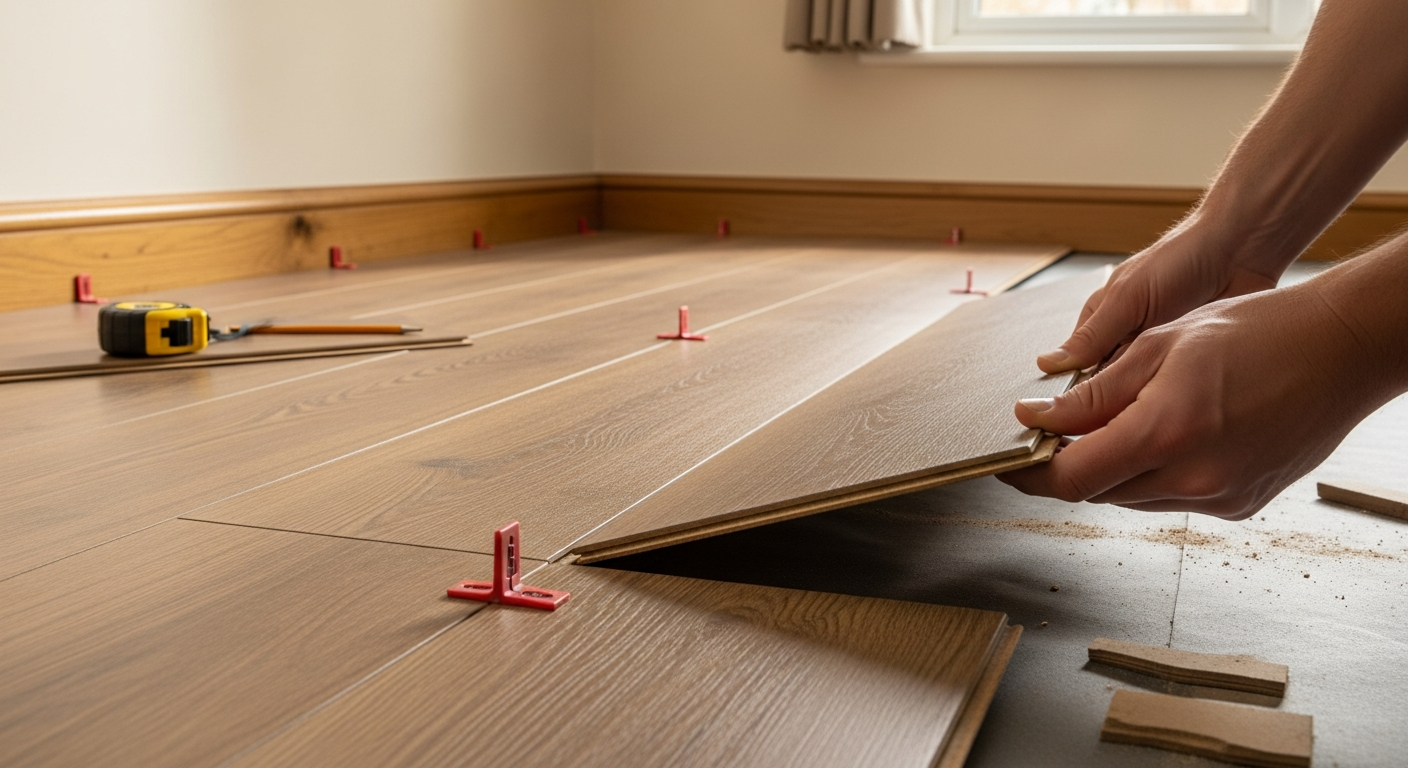
Insufficient expansion gap. Laminate expands and contracts with changes in temperature and humidity. If the gap between the flooring and the skirting boards or walls is too small — typically less than 8–10 mm — the boards have nowhere to move and buckle upwards. This is the most common cause of lifting laminate, particularly in rooms that experience temperature swings. See our guide on how to fix lifting laminate edges for the full repair process.
Moisture ingress or water damage. Laminate is not waterproof. Water from leaks, spills, or a damp subfloor can cause the HDF core to swell, forcing boards to lift or bow. Bathrooms and kitchens are especially prone. If you are choosing a replacement, read our guide to the best flooring for bathrooms before reinstalling laminate.
Uneven or poorly prepared subfloor. Lumps, dips, or debris under the floor prevent boards from lying flat, causing them to flex under foot traffic until the click joints fail and edges lift. A subfloor tolerance of no more than 3 mm over a 1.8 m span is the standard installation requirement. Our guide to fixing a dip in the floor explains how to level problem areas.
Wrong or missing underlay. Underlay cushions the boards and acts as a moisture barrier. Using the incorrect type, doubling up layers, or omitting it entirely creates an unstable base that accelerates joint failure and lifting. The best underlay for laminate guide covers which specification to choose for your subfloor type.
Faulty or failed click joints. If boards were forced together incorrectly during installation, dropped, or exposed to repeated heavy impact, the tongue-and-groove locking system can fracture. Individual boards then become loose and their edges ride up over adjacent planks.
How to Diagnose the Exact Cause
- Check the expansion gap first. Remove the skirting boards or beading along one affected wall. Use a tape measure to check the gap between the last board and the wall. If it is less than 8 mm, or if boards are physically touching the wall, a blocked expansion gap is your primary cause.
- Look for moisture or staining. Lift one of the raised boards by gently unclipping it from its neighbour. Inspect the underside and the subfloor beneath for discolouration, swelling, white mineral deposits, or a damp smell. Any of these indicate water damage.
- Test the subfloor flatness. Place a long spirit level or straight edge across the subfloor where the lifting occurs. A gap of more than 3 mm between the straight edge and the floor surface indicates a high or low spot that needs addressing before relaying.
- Examine the underlay. Check whether underlay is present under the lifted boards. If it is missing, doubled up, or saturated, it will need replacing entirely before the boards go back down.
- Inspect the click joint. Hold a lifted board up to the light and examine the tongue-and-groove edges. Cracked, crumbled, or deformed locking tabs confirm joint failure. Boards with broken joints cannot simply be re-clicked and will need replacing.
- Map the affected area. Walk the whole floor and mark every lifted board with chalk. If lifting is concentrated near one wall it suggests an expansion gap issue; if it is spread across the middle of the room it usually points to subfloor or moisture problems.
How to Fix It
Blocked expansion gap: Remove skirting boards or beading, carefully unclick the affected rows back to the wall, trim 8–10 mm from the edge of the final board, refit and replace the beading to conceal the gap. Do not use sealant to fill the gap. Full instructions in our fix lifting laminate edges guide.
Moisture damage: Identify and resolve the water source first — this is non-negotiable. Once the subfloor is fully dry (allow at least 48–72 hours with ventilation), replace any swollen boards with new boards of matching thickness and species. If the entire floor is saturated, full replacement is the only viable option. Consider whether laminate is appropriate for the room; see our vinyl plank vs laminate comparison for moisture-resistant alternatives.
Uneven subfloor: Use a floor-levelling compound to fill dips or grind down high spots. Allow the compound to cure fully per the manufacturer’s instructions before relaying boards. See our guide to fixing a dip in the floor.
Wrong or missing underlay: Strip up the affected area, remove the old underlay entirely, and lay a single layer of the correct specification underlay with joints butted (not overlapped) and taped. Relay the boards on top.
Failed click joints: Unclick the affected boards back to a sound joint. Replace only the boards with damaged tongues or grooves — do not attempt to glue click-lock joints as this prevents future movement. For a full relaying walkthrough, refer to our how to lay laminate flooring guide.
When to Call a Tradesman
Call a qualified flooring installer if the lifting covers more than a third of the total floor area — large-scale relaying requires precise board sequencing and levelling that is difficult to achieve without experience. If moisture is involved and you cannot identify the source, bring in a damp specialist before touching the floor; laying new boards over an active damp problem will simply repeat the failure. Where the subfloor is a suspended timber floor and boards are flexing significantly underfoot, a structural assessment may be needed before any flooring work proceeds — consult a builder or structural engineer. If your property is a rented home, the landlord has a legal obligation under the Landlord and Tenant Act 1985 to maintain the structure and any fixed floor coverings; report the issue in writing before undertaking repairs yourself.
How to Prevent It Happening Again
- Always leave a correct expansion gap. Maintain a minimum 8–10 mm gap around the entire perimeter of the room, around all fixed obstacles such as pipes and door frames, and at any doorway threshold. Use spacers during installation and remove them only once all boards are laid.
- Acclimatise boards before laying. Store laminate flat in the room where it will be fitted for at least 48 hours prior to installation, allowing it to adjust to the ambient temperature and humidity before clicking together.
- Use a suitable moisture barrier underlay. On solid concrete subfloors always use an underlay with an integral damp-proof membrane; on timber subfloors use a standard foam or fibre underlay of the correct thickness for your board type.
- Wipe spills immediately and avoid wet mopping. Use a barely damp mop rather than a wet one, and dry the surface promptly. Fit door mats at external entrances to reduce moisture tracked in from outside.
Frequently Asked Questions
Can I re-lay lifted laminate boards without buying new ones?
Yes, provided the click joints are undamaged and the boards have not swollen from moisture. Carefully unclick the boards, address the underlying cause, then refit the same boards with the correct expansion gap.
How big should the expansion gap be around a laminate floor?
Most laminate manufacturers specify a minimum gap of 8–10 mm around all fixed edges including walls, door frames, pipes, and kitchen units. Always check the specific instructions supplied with your boards.
Will laminate floor lifting get worse if I leave it?
Yes. Continued foot traffic accelerates joint failure, and if moisture is involved the swelling will spread to adjacent boards. Early intervention almost always means fewer boards need replacing.
Is laminate floor lifting covered by a manufacturer’s warranty?
Most manufacturer warranties exclude lifting caused by insufficient expansion gaps, moisture, or failure to follow installation instructions. Lifting due to a manufacturing defect in the click joint itself may be covered — check your warranty documentation.
Should I use glue to stop laminate boards lifting?
No. Gluing floating laminate boards removes the ability of the floor to expand and contract, which will cause more severe buckling. Address the root cause instead of fixing boards in place.
When relaying boards after addressing an expansion gap issue, run a thin bead of low-tack masking tape across the joints of the last two rows under the skirting — it holds alignment while you refit the beading without the boards springing apart. Remove the tape before pressing the beading down.
Sources
- HSE — Slips and Trips: Guidance on floors in the workplace — hse.gov.uk
- Which? — Laminate flooring buying guide — which.co.uk
- Checkatrade — Cost to repair laminate flooring — checkatrade.com
This guide is for general information only. Always work safely and follow manufacturer instructions. DIYnut accepts no liability for injury or damage arising from DIY work.