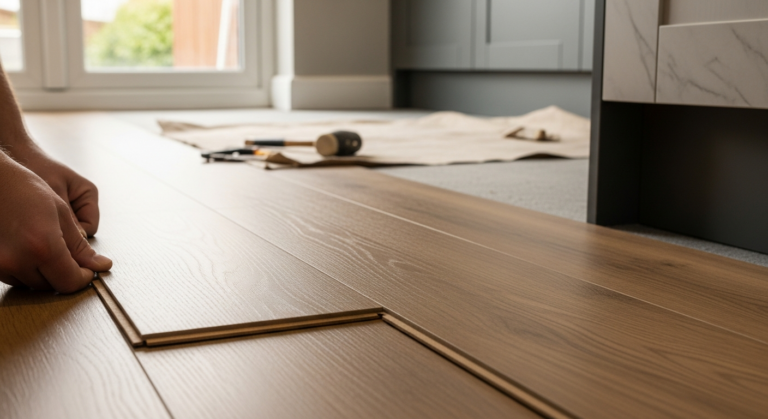
Vinyl Plank vs Laminate Flooring – DIY Guide
Vinyl plank flooring is 100% waterproof and softer underfoot, making it the better choice for kitchens, bathrooms, and hallways. Laminate is harder, more scratch-resistant, and generally looks more convincing as a wood replica. Your decision should hinge on moisture levels, foot traffic, and budget.

- Tape measure
- Pencil
- Moisture meter
- Spirit level
- Utility knife
- Straight edge
- Vinyl plank flooring samples
- Laminate flooring samples
- Underlay (foam or acoustic, as appropriate)
- Moisture barrier sheet
- Expansion gap spacers
- Self-levelling compound (if subfloor is uneven)
Step-by-Step Guide
Assess the room’s moisture levels
Before choosing between vinyl plank and laminate, use a moisture meter on your subfloor. Laminate contains a timber-based core (HDF) that swells and delaminates when exposed to persistent damp — readings above 75% relative humidity at floor level rule laminate out entirely. Vinyl plank is made from a PVC core that is completely unaffected by moisture, making it the only sensible option for bathrooms, wet rooms, kitchens with frequent spills, and below-ground-level rooms. If you are unsure how to read a moisture meter, the Flooring Guide covers subfloor preparation in full.
Compare the core construction of each product
Laminate is built from a high-density fibreboard (HDF) core sandwiched between a photographic wear layer and a stabilising backing board — the printed layer mimics wood grain and can be extremely convincing, particularly in higher-thickness planks (10mm–12mm). Vinyl plank uses a rigid or semi-rigid PVC core topped with a printed film and a clear wear layer measured in mils (thousandths of an inch). Domestic-grade vinyl should carry a wear layer of at least 12 mil; commercial or high-traffic areas need 20 mil or above. Understanding these layers tells you exactly how each product will behave under load and heat.
Evaluate underfoot feel and acoustic performance
Laminate is denser and harder underfoot — it transmits impact noise upwards through the subfloor and can sound hollow or ‘clicky’ unless a quality acoustic underlay is used. Vinyl plank has a built-in resilience that cushions footfall and reduces impact noise naturally; many vinyl planks come with a pre-attached underlay, which both speeds up installation and improves comfort. In a flat above another occupied space, acoustic performance is a material consideration — check your lease or building regulations if relevant. For guidance on choosing the right underlay for laminate, see our best underlay for laminate guide.
Match the product to your traffic level and lifestyle
Laminate wins on surface hardness — the AC (Abrasion Class) rating system grades it from AC1 (light residential) to AC5 (heavy commercial). For a busy family home, specify AC4 minimum. Vinyl plank uses a separate wear-layer thickness system (mil rating) rather than the AC scale, so comparisons require care. Both formats now offer realistic wood-effect finishes, but laminate still leads on visual depth and embossed texture at equivalent price points. If you have dogs or heavy foot traffic, our guide to the best flooring for dogs gives specific product criteria to look for.
Review installation requirements for your specific subfloor
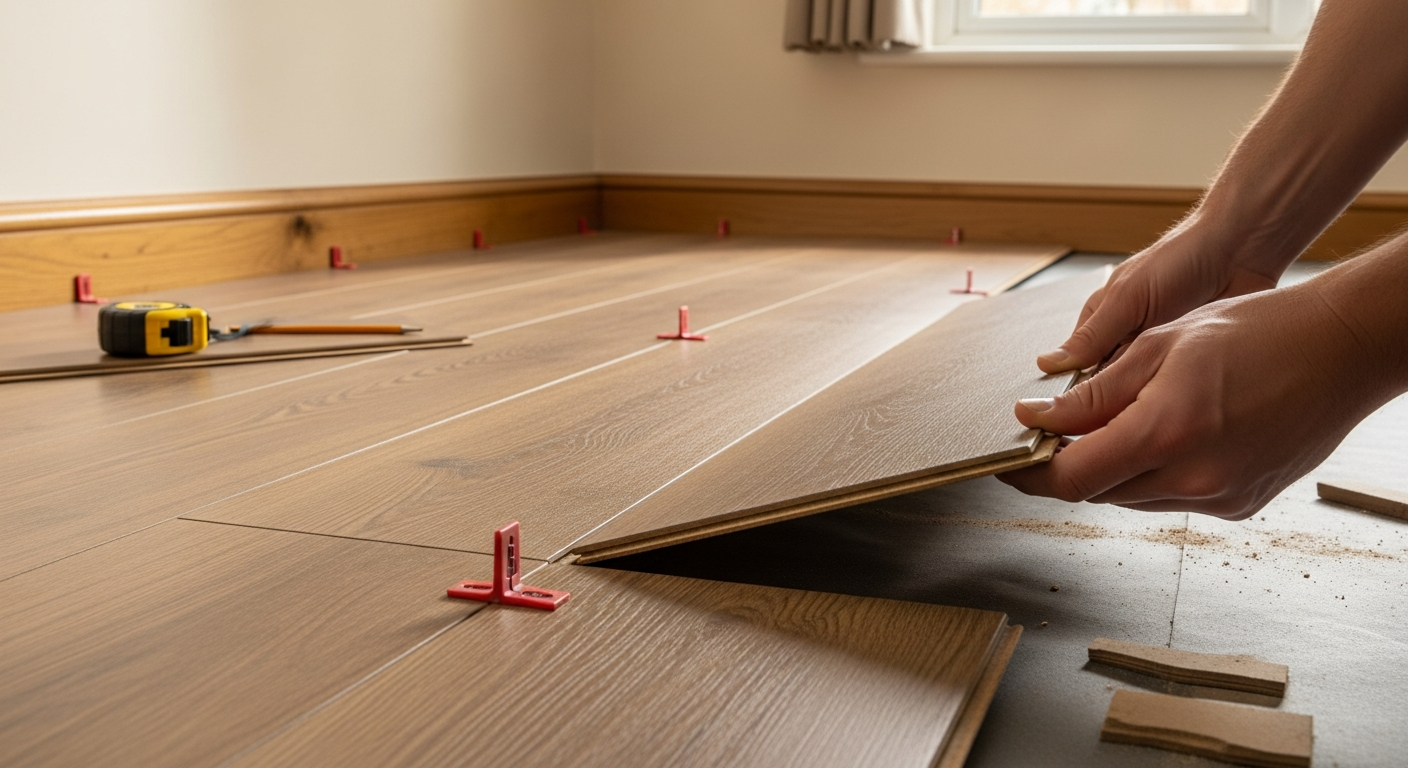
Both products float — neither is glued or nailed to the subfloor directly. However, laminate demands a flatter subfloor: the tolerance is ±3mm over 1.8 metres; beyond that, you must apply self-levelling compound before laying. Vinyl plank is more forgiving of minor undulations. Neither product should be laid directly on a subfloor with significant movement or flex — check that floorboards are secure and joists are sound first. Both use a click-lock system at the joints, though the profiles differ between manufacturers. For a detailed walkthrough of the laying process, see our guide on how to lay laminate around doors, which covers the same threshold and doorframe techniques used for vinyl plank.
Make your final decision based on four criteria
Run through these four checkpoints before buying: 1) Is the room wet or prone to moisture? Choose vinyl plank — no exceptions. 2) Is visual realism the top priority in a dry room? Laminate at 10mm+ thickness generally delivers better grain depth for the price. 3) Is comfort and warmth underfoot important (e.g. a playroom or bedroom)? Vinyl plank. 4) What is your budget per square metre? Both are available from around £15/m² upward — laminate with a convincing finish typically starts around £20/m², while quality vinyl plank starts around £25/m². Once you have chosen, use the buying guide for your chosen product to nail down thickness, wear rating, and underlay before ordering.
Frequently Asked Questions
Is vinyl plank flooring better than laminate for a kitchen?
Yes — for kitchens, vinyl plank is the safer choice. Its PVC core is 100% waterproof, so standing water, steam, and spills will not cause damage. Laminate absorbs moisture at the joints and edges, leading to swelling and delamination. See our guide to the best flooring for bathrooms for the same waterproofing logic applied to wet rooms.
Which is cheaper — vinyl plank or laminate?
Entry-level laminate starts slightly lower per square metre than entry-level vinyl plank, but budget laminate is also lower quality. At the mid-range (where most buyers should be shopping), the price difference is minimal — factor in underlay costs separately, as vinyl plank often comes pre-underlaid while laminate does not.
Can you repair vinyl plank or laminate if a plank gets damaged?
Both can be repaired if the floor was laid as a floating floor and you kept spare planks. With vinyl plank, individual planks can be clicked out and replaced relatively easily. Laminate is slightly more involved — see our guide to how to repair chipped laminate floor for the full method.
Is vinyl plank or laminate better for underfloor heating?
Both are compatible with underfloor heating, but check the manufacturer’s maximum surface temperature limit — typically 27°C for both products. Laminate requires a slower heat-up and cool-down cycle to prevent thermal expansion stress. Vinyl plank is generally more tolerant of temperature fluctuation.
Does laminate look more realistic than vinyl plank?
At equivalent price points, yes — laminate’s photographic layer combined with deep embossing more closely replicates real wood texture and grain depth. However, premium vinyl plank (particularly rigid core products at 8mm+) has closed the gap considerably, and the waterproof advantage often outweighs the visual difference.
When comparing samples in a showroom, bend each plank gently between your hands — a rigid core vinyl plank should have very little flex, indicating a denser core that resists denting under point loads like chair legs and stiletto heels. A plank that flexes easily will telegraph subfloor imperfections and dent under furniture over time, regardless of how good the wear layer is.
Sources
- Which? — Laminate flooring buying guide — which.co.uk
- HSE — Slips and trips: flooring materials and selection — hse.gov.uk
- GOV.UK — Building Regulations Approved Document E (resistance to sound) — gov.uk
This guide is for general information only. Always work safely and follow manufacturer instructions. DIYnut accepts no liability for injury or damage arising from DIY work.