Flat Roof Materials Guide
Flat Roof Materials Guide
Choose the right flat roof material and avoid the costly mistakes most homeowners make.
Flat roof materials in the UK include felt (built-up roofing), EPDM rubber, fibreglass (GRP), and liquid-applied systems. EPDM and GRP are the most durable modern options for DIY, lasting 20–50 years when correctly installed on a properly prepared deck.

- Tape measure
- Utility knife
- Flat roofing roller
- Stiff-bristled brush
- Serrated spreader
- Heat gun
- Safety harness and anchor point
- Chalk line
- EPDM rubber membrane
- GRP fibreglass matting and resin
- Bitumen felt (capsheet)
- Liquid waterproofing membrane
- Plywood decking board (18mm WBP)
- Bonding adhesive
- Edge trim and drip flashing
- Roof primer
Step-by-Step Guide
Assess the existing deck and substrate
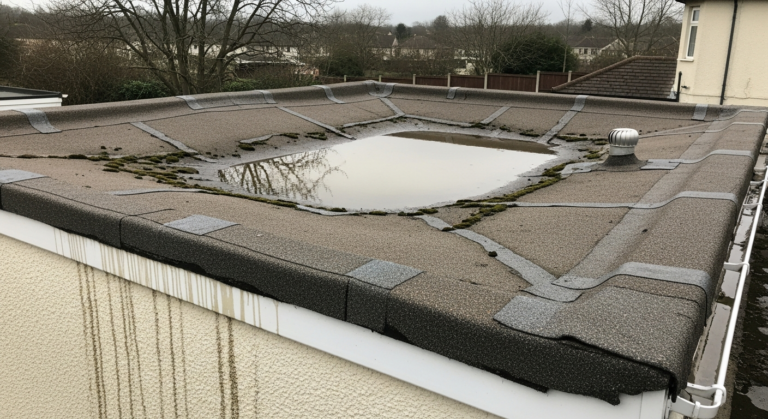
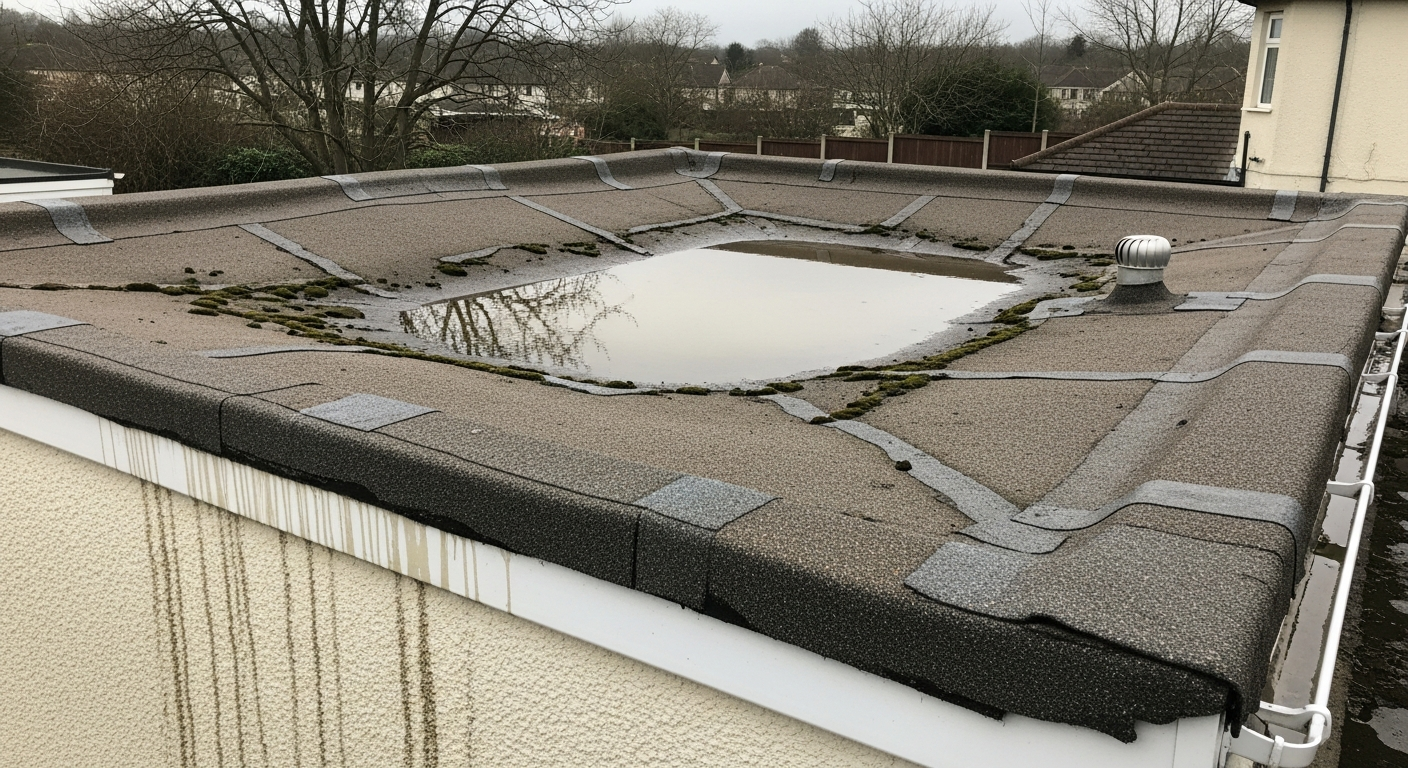
Before choosing a material, inspect the roof deck thoroughly. Flex and probe the decking boards — any soft, spongy, or rotten areas must be replaced with 18mm WBP (weather and boil proof) plywood before any membrane goes down. A failed deck will destroy even the best covering within months. Check for adequate falls: BS 6229 recommends a minimum 1:80 fall on flat roofs to prevent ponding. If the existing fall is insufficient, this is the time to build it up with tapered insulation boards. You can also identify why a flat roof is leaking at this stage before any new covering is applied.
Choose the right material for your roof
Match the material to the job. Mineral felt (built-up roofing) is the cheapest option at roughly £5–£8 per m², but typically lasts only 10–15 years and is labour-intensive to install correctly in three layers. EPDM rubber membrane costs £15–£25 per m², installs cold with bonding adhesive, and can last 50 years or more — it is the most forgiving option for a competent DIYer. GRP (fibreglass) costs £20–£35 per m², is rigid and extremely durable (25–30 years), but requires working quickly with resin before it sets — it suits those with experience of two-part systems. Liquid-applied waterproofing (polyurethane or acrylic) is ideal for awkward shapes and detailing, applied by brush or roller in multiple coats. For a flat roof over a garage, shed, or extension, EPDM is the most recommended DIY-appropriate choice. If you are dealing with an existing felt roof, see our guide on repairing felt on a flat roof before deciding whether a full replacement is needed.
Prepare the deck surface
Clear all debris, strip back the old covering, and replace any damaged decking. Punch down any raised nail heads flush with the surface. Sand or grind down any ridges between boards — membrane laid over an uneven surface will blister, bridge, or split under foot traffic and thermal movement. Apply a solvent-based or water-based primer to the deck if specified by the membrane manufacturer — this is not optional on GRP or liquid systems, as adhesion failures at the deck level are a leading cause of premature flat roof failure. Allow the primer to dry fully before proceeding.
Install edge trims and drip flashings
Fix aluminium or galvanised drip edging around the entire perimeter before laying the membrane. The trim must be screwed at no more than 300mm centres and the inner face must be primed. The membrane will later lap over and bond to this trim — getting the trim level and square first saves significant rework. At abutments (walls, upstands, parapets), fit timber fillet pieces at 45 degrees into internal angles; membrane cannot bridge a right-angle corner without cracking. Check that all outlet pipes and drainage points are clear and that water can exit the roof unobstructed. For chimney or wall abutments, consider how your flashings will integrate — sealing around a chimney is a critical detail on any flat roof adjacent to a stack.
Lay and bond the membrane
For EPDM: roll the membrane out across the deck, allowing it to relax for 30 minutes before bonding. Fold back half the sheet, apply bonding adhesive to both the membrane underside and the deck, leave to flash off (typically 10–20 minutes depending on temperature), then carefully fold the membrane back into position. Work out air bubbles from the centre outward using a flat roofing roller. Repeat for the second half. Bond all laps with lap adhesive or self-adhesive tape and roll firmly. For GRP: mix catalyst into resin per manufacturer ratio, apply to primed deck, lay fibreglass matting, stipple resin through with a paddle roller to fully wet out, and allow to cure before applying topcoat. For liquid systems, apply in the specified number of coats — do not try to apply a thick single coat to save time; it will cure unevenly and fail. For tips on what to do if a new installation develops a fault, see our guide to fixing a leaking flat roof.
Finish edges, upstands, and drainage details
Trim the membrane flush with or slightly over the drip edge, then bond and clamp it to the trim face. At upstands, take the membrane at least 150mm up the vertical face and terminate with a mechanically fixed termination bar and sealant. Do not rely on adhesive alone on vertical surfaces — thermal movement will peel it back within a season. Check every outlet, pipe collar, and corner detail before signing the job off. Apply a UV-protective topcoat if your membrane requires it (liquid systems and some GRP topcoats degrade without it). Allow full cure time before allowing foot traffic — 24 hours minimum for most systems, 48 hours for GRP in cold weather.
Frequently Asked Questions
Which flat roof material lasts the longest?
EPDM rubber membranes have the longest proven track record, with quality installations lasting 40–50 years or more. GRP fibreglass typically achieves 25–30 years, while traditional mineral felt rarely exceeds 15 years. Longevity in any system depends more on correct installation and detailing than on the material itself.
Can I install a flat roof membrane myself?
EPDM and liquid-applied systems are within reach of a competent DIYer with patience and the right preparation. GRP fibreglass is more demanding due to its short working time and the need to wet out the matting before resin sets — it is not recommended for a first attempt without prior experience of working with resins. Always check whether your roofing system comes with a manufacturer-backed guarantee, as some require professional installation to validate the warranty.
Do I need planning permission to replace a flat roof?
In most cases, replacing a flat roof with the same or similar material is classed as permitted development and does not require planning permission. However, if the property is listed or in a conservation area, or if you are altering the roof height or adding insulation that changes the roof profile significantly, you should check with your local planning authority before starting. See our full roofing guide for more on regulatory requirements.
How do I know if my flat roof needs replacing or just repairing?
If the existing covering is under 10 years old and the leak is isolated to a single detail (a split seam, a lifted edge, or a cracked pipe collar), a targeted repair is usually viable. If the membrane is brittle, extensively cracked, blistered across large areas, or more than 15 years old, a full strip and re-cover is more cost-effective in the long run. Our guide on repairing felt on a flat roof covers the repair-vs-replace decision in detail.
How much does a flat roof cost to replace in the UK?
DIY material costs typically run from £15–£35 per m² depending on system choice, plus decking if required. A professionally installed EPDM or GRP roof on a standard single-storey extension (around 20 m²) typically costs £1,500–£3,500 including labour, materials, and disposal of the old covering. Prices vary significantly by region and complexity of detailing.
When bonding EPDM in temperatures below 10°C, warm the adhesive tin in a bucket of warm water for 10 minutes before use — cold adhesive flashes off slowly and stays tacky too long, causing the membrane to shift after laying and producing wrinkles that cannot be worked out once the bond has set.
Sources
- HSE — Work at height regulations and guidance for roofing work — hse.gov.uk
- BSI — BS 6229:2003 Flat roofs with continuously supported flexible waterproof coverings — Code of practice — bsigroup.com
- Planning Portal — Permitted development rights for householders: technical guidance — planningportal.co.uk
This guide is for general information only. Always work safely and follow manufacturer instructions. DIYnut accepts no liability for injury or damage arising from DIY work.