How to Clear Blocked Gutters – DIY Guide
To clear blocked gutters, work from a stable ladder, scoop out debris by hand or with a gutter scoop, flush the channel with water, then check the downpipe is flowing freely. The job takes 1–2 hours and costs very little in materials.


- Extension ladder
- Ladder stand-off bracket
- Gutter scoop
- Stiff-bristle brush
- Garden hose with adjustable nozzle
- Bucket
- Safety gloves
- Safety goggles
- Refuse sacks for debris
- Gutter sealant
- Replacement gutter union clip
- Wire mesh downpipe cage
- Mild detergent
- Clean water
Step-by-Step Guide
Set Up Your Ladder Safely
Position your extension ladder on firm, level ground and use a ladder stand-off bracket to hold it away from the gutter — leaning directly against plastic guttering can crack it. Never overreach; move the ladder along as you work rather than stretching sideways. The HSE recommends a 1-in-4 angle for ladder use, so for every 4 metres of height, the base should sit 1 metre out from the wall. Always tell someone you are working at height.
Remove Debris by Hand
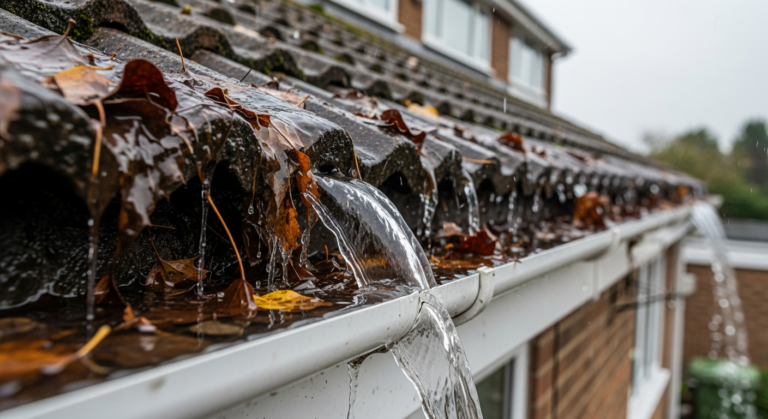
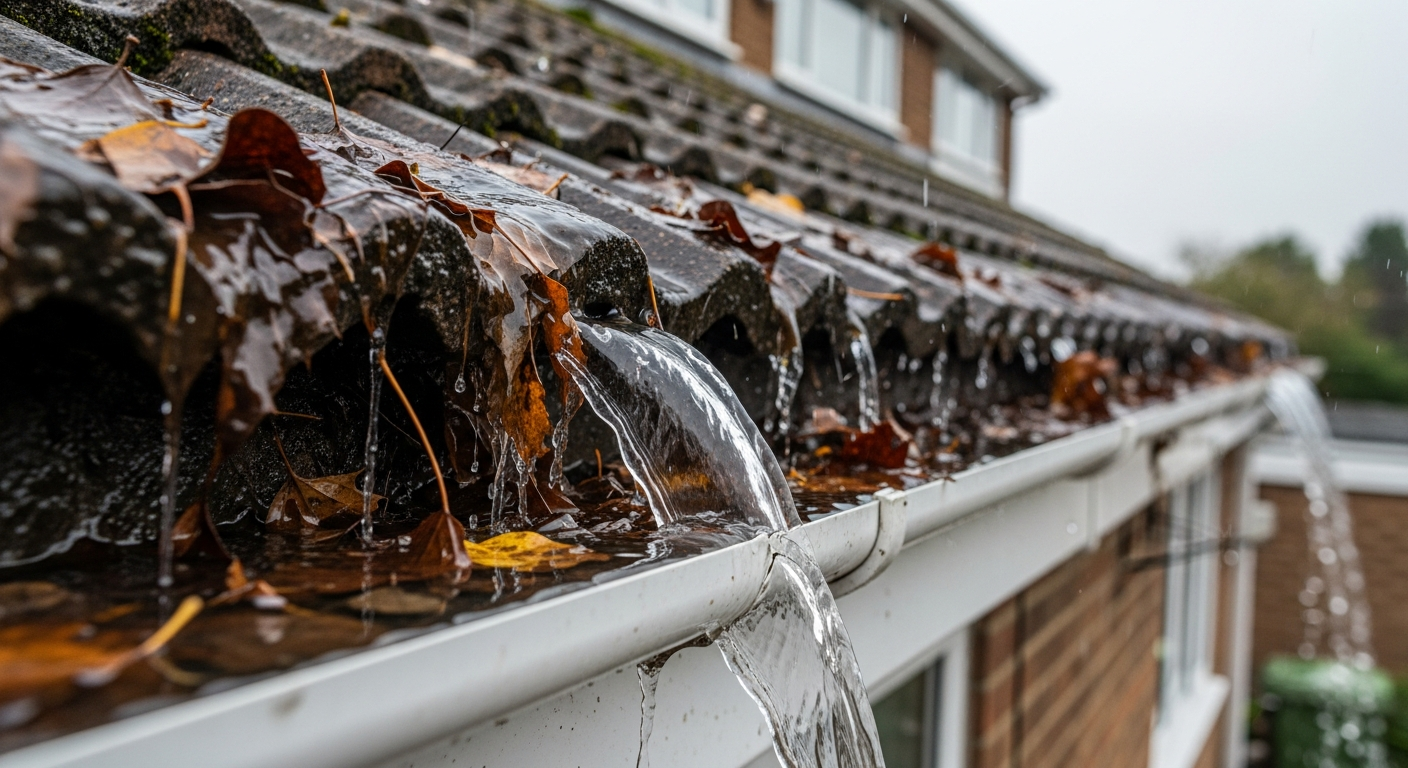
Starting at the end furthest from the downpipe, use a gutter scoop or gloved hand to lift out leaves, moss, and compacted debris, dropping it into a bucket rather than onto the ground below. Work systematically towards the downpipe outlet so you are pushing blockages out rather than packing them tighter. Stubborn moss can be loosened with a stiff-bristle brush — the same technique used when you need to fix leaking gutters caused by overflowing debris.
Clear the Downpipe
Once the channel is clear, check the downpipe by running water from a garden hose into the gutter at the far end and watching it exit at the bottom. If flow is slow or absent, feed a length of garden hose upward from the bottom of the downpipe and flush forcefully — this dislodges most blockages. For a stubborn plug, a plumber’s drain rod pushed down from the top will shift compacted material without damaging the pipe.
Flush the Full Length of Guttering
Run water along the entire gutter run to confirm free flow and reveal any areas where water pools rather than drains. Standing water indicates the gutter has lost its fall — a minimum gradient of 1 in 600 (roughly 5 mm per metre) is needed to drain effectively toward the downpipe. If pooling persists, the bracket fixings may need adjustment — a problem closely related to a sagging gutter that requires attention separately.
Inspect and Seal Any Leaking Joints
With water flowing, check every union joint and corner piece for drips. Dry the joint thoroughly, remove any old dried sealant with a stiff brush, and apply a bead of gutter sealant to the inside of the joint before clipping the sections back together. A poorly sealed joint will allow water to track down the fascia and cause rot over time — which can eventually lead to the need to fix a roof leak caused by saturated timbers.
Fit a Wire Mesh Cage and Clear Away
Push a wire mesh cage into the top of each downpipe outlet to prevent debris re-entering — this is the single most effective measure for extending the time between clears. Bag all debris, dispose of it in your green waste bin, and store your tools clean and dry. Clear gutters twice a year: once in late autumn after leaf fall, and once in spring after moss and lichen growth. If your roof has experienced damage recently, also review our guide on how to replace a broken roof tile to keep the whole system watertight.
Frequently Asked Questions
How often should I clear my gutters in the UK?
Twice a year is the standard recommendation — once in late autumn after leaves have fallen, and once in early spring to remove moss and debris that builds up over winter. Properties surrounded by large trees may need clearing three or four times a year.
Can blocked gutters really cause structural damage?
Yes. Overflowing water saturates fascia and soffit boards, causes damp to penetrate internal walls, and — in prolonged cases — undermines foundations if it drains adjacent to the building. Which? advises treating gutter maintenance as essential rather than optional home care.
What is the safest way to clear gutters without a ladder?
Telescopic gutter cleaning attachments that connect to a garden hose or wet-and-dry vacuum allow you to clear single-storey gutters from ground level. They are slower than working from a ladder but remove the risk of a fall entirely — a worthwhile trade-off for many homeowners.
Why does my gutter still overflow after I have cleared it?
Should I hire a professional to clear my gutters?
For a single-storey property with a stable surface to work from, most competent DIYers can clear gutters safely themselves. For two-storey or taller properties, or where access is difficult, hiring a professional with appropriate access equipment is the safer choice — the HSE Working at Height Regulations 2005 require that all work at height is properly planned and carried out by a competent person.
Before you flush the gutter with a hose, stuff a rag loosely into the top of the downpipe — this lets you flush the full channel length and inspect the flow before the water exits at the bottom, so you can spot low spots and poor joints under pressure rather than just looking for visible debris. Remove the rag slowly to release the backed-up water and watch exactly where it settles.
Sources
- HSE — Working at Height Regulations 2005: Guidance for the public — hse.gov.uk
- Which? — How to clean gutters — which.co.uk
- GOV.UK — Health and Safety at Work etc. Act 1974 — legislation.gov.uk
This guide is for general information only. Always work safely and follow manufacturer instructions. DIYnut accepts no liability for injury or damage arising from DIY work.