Roof Leaking
A leaking roof is most commonly caused by damaged or slipped tiles, failed flashing around chimneys or skylights, or a deteriorating flat roof membrane. Identify where water is entering before attempting any repair — most causes are DIY-fixable if caught early.

What’s Causing This?
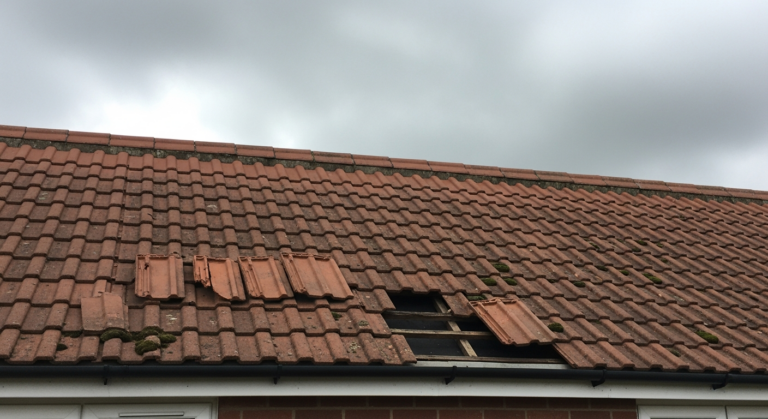
Damaged or slipped roof tiles — The most common cause of a leaking roof in the UK. Tiles crack under frost, shift with age, or are dislodged by wind. Once displaced, rainwater runs straight into the roof structure beneath. See our guide to replacing a broken roof tile for the repair steps.
Failed or lifted roof flashing — Lead or aluminium flashing seals the joints around chimneys, skylights, and roof abutments. It corrodes, cracks, or pulls away from the mortar over time, letting water track down into ceilings and walls. Read how to seal roof flashing yourself.
Chimney defects — Cracked flaunching (the mortar bed around chimney pots), failed pointing, or deteriorating lead soakers around the chimney base all allow water ingress. These are often misdiagnosed as a general roof leak. See how to fix a roof leak around a chimney.
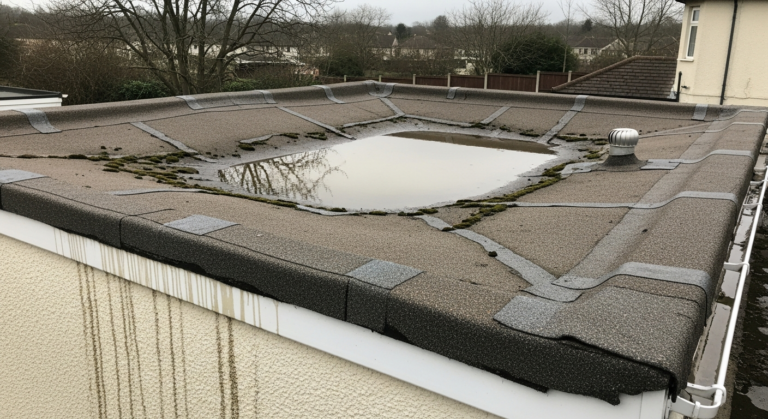
Flat roof membrane failure — On felt, GRP, or EPDM flat roofs, splits, blisters, and ponding water cause leaks that can be difficult to trace. Felt flat roofs are particularly vulnerable after ten or more years. Our felt flat roof repair guide covers the main patching methods.
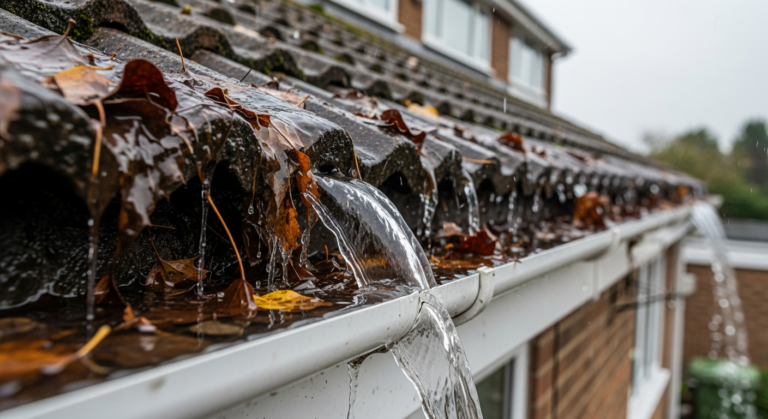
Blocked or overflowing gutters — When gutters fill with debris, water backs up under the roof edge or saturates the fascia board, eventually soaking through to the ceiling below. This is often mistaken for a tile problem. See our guide to fixing leaking gutters and consider fitting a gutter guard to prevent repeat blockages.
How to Diagnose the Exact Cause
- Find the wet patch indoors. Go into the loft during or just after rainfall. Note exactly where water is dripping or where the felt underlay is wet. Mark it with chalk if needed — this narrows the external search area significantly.
- Check the loft in daylight without a torch. Turn off your torch and look for pinpricks of daylight through the roof covering. Any visible light indicates a gap, cracked tile, or lifted flashing.
- Inspect the roof from ground level with binoculars. Look for missing, cracked, or slipped tiles; lifted ridge tiles; and any flashing that appears buckled, cracked, or pulled away from the chimney or wall.
- Check your gutters. After rain, look for water spilling over the front or back of the gutter. Overflowing gutters cause water to saturate the fascia and soffit, mimicking an internal leak. Inspect for blockages, sags, and failed joints.
- Examine all flashings and the chimney. From a safe vantage point or ladder (with a second person present), inspect the flashing at any chimney, skylight, or roof-to-wall junction. Look for gaps in the mortar, cracked lead, or lifted edges.
- Assess the flat roof surface if applicable. Walk carefully on a flat roof only if it is structurally sound. Look for blisters, splits, standing water, or areas where the membrane has pulled away from upstands or edges.
- Trace the water run path inside. Water rarely drops directly below its entry point — it travels along rafters and joists. Use your loft inspection data alongside the damp patch location to triangulate the true entry point before climbing onto the roof.
How to Fix It
Damaged or slipped tiles: Re-seat slipped tiles by hand if they are intact. Replace cracked or broken tiles using a tile lifter or slate ripper. Full instructions in our guide to replacing a broken roof tile. If ridge tiles are loose or missing, see how to re-ridge a roof.
Failed flashing: Clean back the old sealant or mortar, rebed or re-dress the flashing, and reseal with appropriate flashing tape or lead soakers. See the full process in our seal roof flashing guide.
Chimney defects: Repoint the chimney brickwork and repair the flaunching mortar bed. See how to repoint a chimney and how to repair chimney flaunching.
Flat roof membrane failure: For felt roofs, cut out blistered sections, dry thoroughly, and bond in a matching felt patch. For GRP or EPDM, use manufacturer-matched repair kits. Full steps in our fix a leaking flat roof guide.
Blocked or overflowing gutters: Clear debris by hand or with a gutter scoop, flush with a hosepipe, and check fall angles. Replace cracked sections where needed. See how to clear blocked gutters and how to replace a gutter section.
Emergency temporary repair: If you need to stop water ingress immediately while you arrange a full fix, our emergency roof repair guide covers short-term options including roof tarpaulins and temporary sealants.
When to Call a Tradesman
Call a qualified roofing contractor if the leak is widespread or you cannot identify a single discrete entry point — this may indicate widespread felt underlay failure or multiple tile failures requiring a full roof inspection. Any work that requires access to a pitched roof above single-storey height should only be carried out from properly erected scaffold or a hired scaffold tower; working from a ladder on a pitched roof is high-risk and is contrary to HSE working at height guidance (HSE, Working at Height Regulations 2005). If you suspect structural rafter or purlin damage — indicated by a sagging or uneven roofline — do not walk on the roof and engage a structural engineer or specialist roofing contractor immediately. Flat roofs with GRP or EPDM membranes that have widespread delamination or persistent ponding are best assessed by a specialist, as poor DIY repair can invalidate any remaining manufacturer warranty. For leaks originating from party walls or shared chimney stacks in a terrace or semi-detached property, you may need to involve your neighbour and comply with the Party Wall Act 1996 before carrying out structural repairs.
How to Prevent It Happening Again
- Inspect the roof and gutters every autumn. Clear gutters of leaves and debris before winter, check for slipped or cracked tiles from ground level with binoculars, and look for any lifted flashing. Catching small problems early prevents water from penetrating the roof structure.
- Check all flashings and chimney joints every two years. Mortar and sealant around flashings, chimney flaunching, and soakers deteriorate with freeze-thaw cycles. Catching hairline cracks early is a simple, low-cost fix compared with replacing water-damaged timbers.
- Keep gutters clear year-round by fitting gutter guards. Mesh or foam gutter guards significantly reduce leaf and moss build-up. See our guide to installing a gutter guard.
- Treat moss and algae on the roof surface. Moss retains moisture against tile surfaces and accelerates frost damage and deterioration of mortar joints. Apply a biocide solution in dry weather and brush off dead growth once treated — do not pressure-wash roof tiles as this damages the surface coating.
Frequently Asked Questions
How do I find where my roof is leaking from inside the loft?
Go into the loft during or after rainfall and look for drips, wet felt underlay, or damp timber. In daylight, turn off your torch and look for pinpricks of light — these indicate gaps in the roof covering. Our guide to finding a roof leak from inside covers the process step by step.
Can I fix a leaking roof myself?
Many common causes — slipped tiles, blocked gutters, and failed flashing sealant — are well within DIY capability at low-to-medium height with the correct access equipment. Widespread membrane failure, structural damage, or work at significant height should be left to a qualified contractor for safety reasons.
Why is my ceiling leaking but there are no missing tiles?
Water often enters through failed flashing around a chimney, skylight, or roof-wall junction rather than through the tiles themselves. It can also be caused by overflowing gutters soaking through the fascia, or by a cracked felt underlay that allows condensation or wind-driven rain to penetrate even when tiles appear intact.
How much does it cost to repair a leaking roof in the UK?
Costs vary widely depending on the cause and access required. A straightforward tile replacement or gutter repair can cost £150–£400 including labour, while chimney flashing work typically runs from £300 upwards. Full flat roof replacement is significantly more expensive. Checkatrade publishes indicative roofing repair costs based on real job data.
Does a leaking roof need to be fixed urgently?
Yes — even a slow drip will saturate roof timbers, insulation, and plasterboard within days, leading to rot, mould, and structural damage that is far more costly to repair. If you cannot fix it immediately, use a temporary measure such as a roof tarpaulin and arrange a proper repair as soon as possible.
When tracing a roof leak, always check the underside of the felt underlay at least a metre upslope from where the water is dripping inside — water tracks along the felt before it drops, so the actual entry point is almost never directly above the wet patch on the ceiling. Probe along the rafter with a dry cloth to find the true source before climbing onto the roof.
Sources
- HSE — Working at Height Regulations 2005: Guidance for employers and employees — hse.gov.uk
- Checkatrade — Roof repair costs UK — checkatrade.com
- Which? — How to find and fix a roof leak — which.co.uk
This guide is for general information only. Always work safely and follow manufacturer instructions. DIYnut accepts no liability for injury or damage arising from DIY work.