How to Install an Outdoor Security Light – DIY Guide
How to Install an Outdoor Security Light
Fit a mains-powered PIR security light safely and get reliable coverage first time.
Installing an outdoor security light involves turning off the mains supply, running a weatherproof cable from a fused spur, mounting a PIR floodlight to the wall, making safe connections inside the fitting, then testing the motion sensor range and sensitivity. Most competent DIYers complete the job in two to three hours.

- Crosshead screwdriver
- Flat-head screwdriver
- Electric drill with masonry and wood bits
- Spirit level
- Wire strippers
- Voltage tester (non-contact)
- Pencil
- Safety goggles
- PIR outdoor security light (IP44 rated or above)
- Weatherproof fused spur with neon indicator
- 2.5mm² twin and earth cable (suitable for external use)
- Weatherproof cable conduit or armoured cable
- Wall plugs and exterior-grade screws
- Weatherproof gland fittings
- Exterior-grade silicone sealant
- Electrical insulating tape
Step-by-Step Guide
Isolate the Power and Verify the Circuit is Dead
Switch off the relevant circuit breaker at the consumer unit and lock it off or tape it clearly to prevent accidental reinstatement. Use a non-contact voltage tester at the fused spur or junction point you plan to work from to confirm there is no live voltage before touching any wiring. This is the single most important step — never rely on the switch alone. Under Part P of the Building Regulations, any new circuit or extension to a circuit in a special location must either be carried out by a competent registered electrician or notified to your local building control authority; check the Smart Home Guide for a full overview of what falls inside and outside notifiable work.
Choose the Mounting Position and Mark the Fixings
Mount the light at a height of 2.4–3 metres for effective PIR coverage of the detection zone — too low and it triggers on small animals, too high and the detection cone misses people at close range. Hold the backplate against the wall, use a spirit level to check it is plumb, and mark the fixing holes with a pencil. Check for buried cables or pipes using a detector before drilling. If you are fitting to a masonry wall, use a masonry bit of the correct diameter for your wall plugs. Consider the cable route at this stage so you choose the most direct, protected path from the power source to the fitting.
Run and Protect the Supply Cable
Run 2.5mm² twin and earth cable from a weatherproof fused spur (rated at 13A and protected by the appropriate MCB on your consumer unit) to the light position. Cable run outdoors must be protected from physical damage — use rigid weatherproof conduit on exposed surfaces or, for runs across a wall cavity or underground, use armoured cable. Feed the cable through a weatherproof gland into the back of the fitting or junction box; never allow the cable to enter an outdoor fitting without a proper gland, as water ingress will cause a fault and potential shock hazard. This wiring work, if it extends beyond like-for-like replacement on an existing circuit, is notifiable under Part P — if in any doubt, use a registered electrician. For a related project see our guide on how to install a video doorbell, which covers a comparable external power supply approach.
Connect the Wiring Inside the Fitting
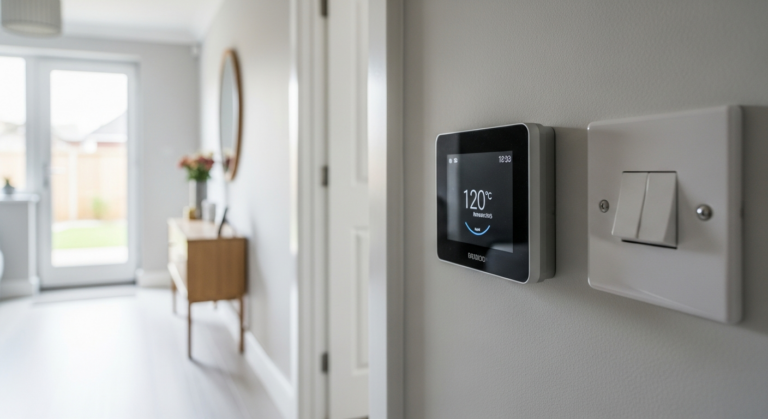
Following the wiring diagram supplied with your light, connect the live (brown) to the live terminal, neutral (blue) to neutral, and the earth (green and yellow sleeved) to the earth terminal — always sleeve bare earth conductors before connecting. Tighten all terminals to the torque specified in the fitting’s instructions; loose connections cause arcing and are a fire risk. Double-check that no bare conductor is exposed outside its terminal and that the cable is anchored by its gland so tension is never carried by the wire connections themselves. Installing a smart thermostat involves a very similar terminal connection process if you want to build your wiring confidence further.
Mount the Light and Weatherproof the Fixing Points
Screw the backplate firmly to the wall using exterior-grade screws and the wall plugs you set earlier, making sure it sits flat and true. Apply a bead of exterior-grade silicone sealant around the back edge of the fitting where it meets the wall to prevent water tracking behind the plate and into the cable entry point. Allow the sealant to skin before restoring power. Ensure the cable conduit entry point is also sealed.
Restore Power and Calibrate the PIR Sensor
Restore power at the consumer unit and allow the PIR sensor a 60-second warm-up period before testing — most sensors have a brief stabilisation delay on first energising. Walk through the detection zone to confirm the light triggers at the correct distance; use the adjustment controls on the PIR head (typically lux threshold, time-on duration, and sensitivity) to fine-tune the response. Aim the sensor head so the detection zone covers the approach path, not the boundary fence or a road, to minimise false triggers. For further ideas on expanding your home security setup, see our guide on how to install a video doorbell alongside your new light.
Frequently Asked Questions
Do I need to notify building control to install an outdoor security light?
In England and Wales, electrical work outdoors (or in special locations such as bathrooms) is notifiable under Part P of the Building Regulations unless you are a registered competent person. Adding a new circuit or a new fused spur from a ring main to power an outdoor light is notifiable work — either use a Part P registered electrician, or submit a Building Regulations application to your local authority. Replacing a like-for-like fitting on an existing external circuit is not notifiable. The HSE and gov.uk both publish guidance on Part P responsibilities.
What IP rating does an outdoor security light need?
For a wall-mounted position under a sheltered soffit, IP44 is the minimum acceptable rating. For a fully exposed position — a gable end, a gate post, or anywhere directly exposed to rain — you need IP65 or higher. The IP rating is always printed on the fitting’s packaging and data plate; never fit a light with a lower rating than the location demands.
Can I connect an outdoor security light to a plug socket instead of a fused spur?
Only if the fitting is specifically designed and rated as a plug-in unit and the socket itself is a dedicated weatherproof exterior socket. Running a standard extension lead through a wall or window to power a hardwired outdoor light is not safe — it compromises the cable’s insulation and leaves the connection point exposed to weather. For a permanent installation, a properly wired weatherproof fused spur is always the correct approach.
Why does my PIR security light keep triggering when nobody is there?
False triggers are almost always caused by one of three things: the sensitivity dial set too high, the sensor aimed at a heat source (flue, road, direct sun on a light-coloured wall), or insects or spiders crossing the lens face. Reduce the sensitivity setting first, then recheck the aim; clean the PIR lens cover with a dry cloth to remove debris. Pairing your security light with a video doorbell lets you review recordings to identify exactly what is triggering the sensor.
How long do LED outdoor security light bulbs last?
Integrated LED outdoor security lights are typically rated between 25,000 and 50,000 hours of use by manufacturers — at five hours of triggered use per night that equates to 13–27 years. However, this lifespan assumes correct voltage supply and adequate heat dissipation; fitting a light flush to an enclosed surface without ventilation, or operating it on an unstable voltage supply, can significantly reduce LED longevity.
Before you make a single connection, use a cable tracer to map the exact route of any existing external wiring in the wall — even brand-new builds often have undocumented circuits clipped inside the cavity. When you seal the backplate, leave a tiny weep gap at the very bottom of the silicone bead so any condensation that forms inside the fitting can drain out rather than pooling on the terminal block.
Sources
- HSE — Electrical safety and Part P Building Regulations — hse.gov.uk
- gov.uk — Building Regulations: electrical safety (Part P) — gov.uk
- NICEIC — Find a registered electrician and competent person scheme — niceic.com
Safety Notice: Electrical and plumbing work can be dangerous if done incorrectly. In the UK, certain electrical work must comply with Part P of the Building Regulations and certain plumbing work with Part G. If in doubt, consult a qualified electrician (NICEIC/NAPIT registered) or plumber (CIPHE/WaterSafe registered). This guide is for general information only — it is not a substitute for professional advice.